
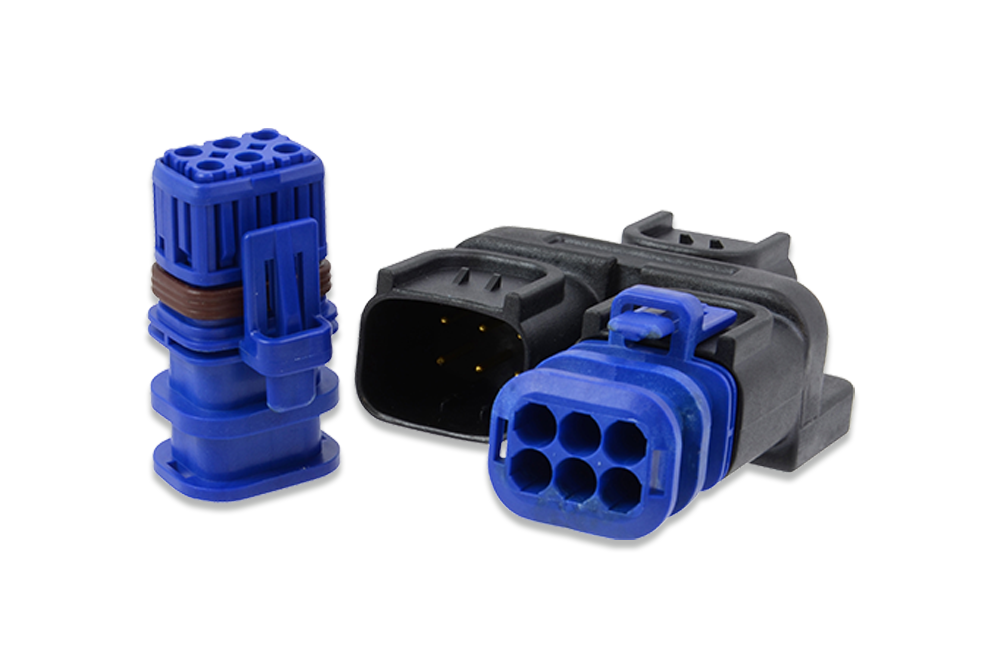
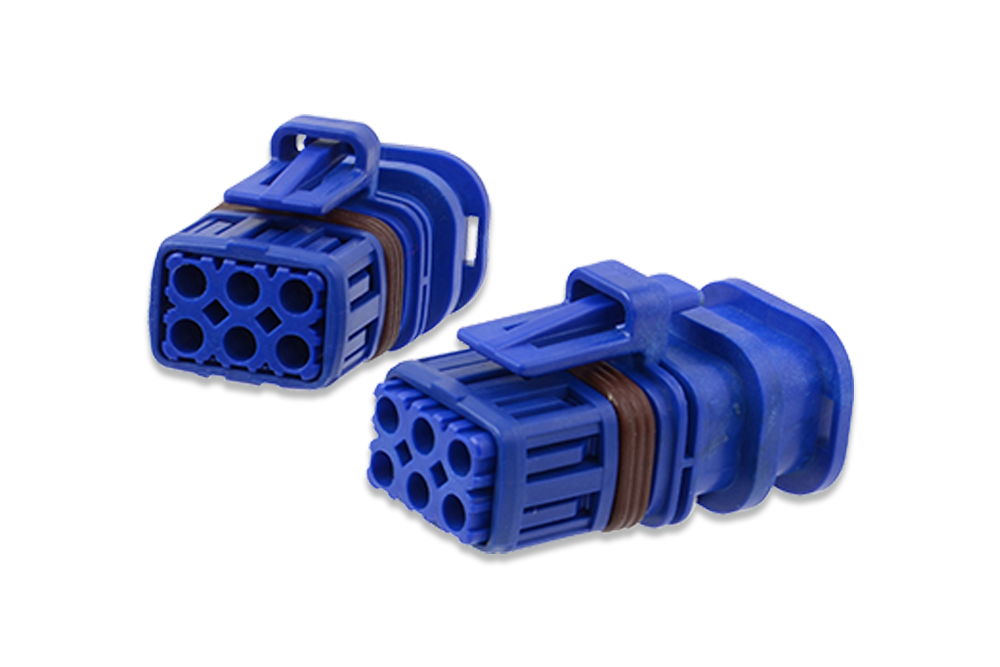
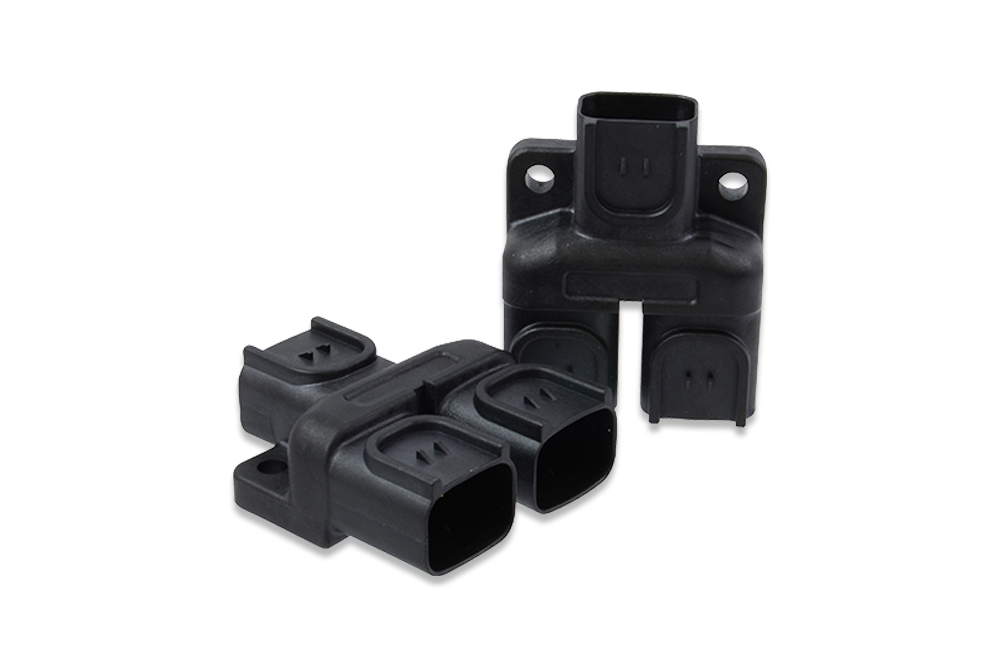
Tru-Loc® Splitter | Rugged CANbus Splitter Connector
CANbus branching for power and signal harnesses
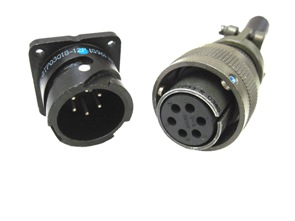
The Tru-Loc® CANbus Splitter Connector from Amphenol Industrial Operations is a rugged solution engineered to simplify power and signal distribution in harsh environments. Built on the trusted Tru-Loc® platform, this compact CANbus splitter connector allows the branching of power and CANbus communication signals across multiple harnesses, reducing connector count and simplifying vehicle network architecture. Its ability to support both communication and low-power distribution makes it an ideal solution for modern vehicle systems requiring efficiency and reliability.
At a Glance
- 6
- Contacts
- 120 Ω ±10%
- Pair impedance
- 13A
- Contact capability
- 16 / 20 AWG
- Wire sizes
- IP67
- When mated
Key Features
Engineer Benefits
120 Ohm +/-10% controlled impedance between two sets of contact pairs
Two contact-pair sets provide controlled impedance for CAN communication.
- Helps limit signal reflections.
- Supports differential-pair signal integrity.
- Provides a defined interface for communication links.
Up to 13 amp current capability per contact & Dielectric withstanding 1600VAC rms
Up to 13 A contact capability and 1600 VAC rms dielectric withstand support the specified interface; withstand is a test rating.
- Supports higher-current power paths.
- Provides an interface for power distribution.
- Allows conductor and connector sizing around the load.
Ability for Signal & Power in one connector
Signal and low-power circuits share a compact splitter.
- Combines required circuits within one interface.
- Supports different equipment configurations.
- Reduces the need for separate connector families.
IP 67 Sealing Protection
Mated IP67 sealing supports outdoor and vehicle harnesses.
- Helps keep moisture away from contacts.
- Limits contamination at the interface.
- Supports equipment exposed to outdoor conditions.
High integrity electrical connections utilizing RADSOK® design contacts
RADSOK® contacts support stable electrical performance.
- Reduces resistive losses at the interface.
- Supports stable current transfer.
- Limits mating effort through the contact design.
Applications

eMobility
Automotive sensor and control networks

Energy Storage
CAN-based storage modules

Factory Automation
Stationary CAN equipment

Heavy Equipment
Off-road and agricultural CAN networks
Engineer Tips
Network architecture
Check CAN-high/CAN-low branching, shield continuity and termination against the complete network design.
Termination option
Use the separate 6-way 120 Ohm resistor-plug option only where the network requires termination.
Temperature
Select the exact part for the required ambient temperature and confirm whether its limit is +125°C or +150°C.
Electrical class
Treat 1600 VAC rms as dielectric withstand; verify working voltage and current for the cable and contact.
Frequently Asked Questions
How are the communication pairs controlled?
Two contact-pair sets provide controlled impedance for CAN communication.
How is current capability specified?
Up to 13 A contact capability and 1600 VAC rms dielectric withstand support the specified interface; withstand is a test rating.
What circuit layouts are supported?
Signal and low-power circuits share a compact splitter.
Design and Integration
Modern vehicle and industrial systems increasingly rely on CANbus networks for communication between sensors, controllers, and electronic units. The Tru-Loc® Splitter provides an ideal solution for these applications, supporting CAN-high, CAN-low, ground, shielded circuits, I/O power, and low amperage power distribution in a single compact unit. This CANbus splitter connector helps simplify harness complexity while maintaining robust signal integrity across the network, ensuring stable data transmission even under harsh operating conditions.
Maintaining impedance is critical for reliable CANbus communication. The Tru-Loc® Splitter is specifically designed to maintain a 120 Ohm impedance between power and CAN circuits, ensuring optimal signal performance throughout the network. This characteristic allows the CANbus splitter connector to minimize signal reflections, maintain data integrity, and prevent transmission errors. Amphenol also offers a 6-way terminating resistor plug option with a pre-installed 120 Ohm resistor, providing a complete solution for efficient network termination in CAN systems.
Supporting both 16 AWG and 20 AWG wire sizes, the Tru-Loc® Splitter offers flexibility for different system requirements. By consolidating both power and CANbus circuits into a single connector system, the Tru-Loc® CANbus splitter connector significantly reduces the number of connectors and harnesses required, leading to reduced vehicle weight, lower assembly costs, and simplified serviceability. This optimization is critical for automotive OEMs, heavy machinery manufacturers, and industrial system designers seeking to streamline cable management and increase system efficiency.
Technical Highlights
- Voltage: 1600 Vac RMS
- Current Rating: 13A
- Number of contacts: 6
- Mating cycles: 20
- Wire size (mm²): 16 AWG or 20 AWG
- Contact plating: Gold
- Contacts: Copper alloy
- Sealing components: Silicone
- Shell: Nylon
Specifications
| Voltage | 1600 Vac RMS |
|---|---|
| Current Rating | 13A |
| Number of contacts | 6 |
| Mating cycles | 20 |
|---|---|
| Wire size (mm²) | 16 AWG or 20 AWG |
| Contact plating | Gold |
|---|---|
| Contacts | Copper alloy |
| Sealing components | Silicone |
| Shell | Nylon |
| Temperature range | -40°/+125°C |
|---|---|
| Protection class | IP67 |
| RoHS | Yes |
| REACH | Yes |
| Body vibration | 32 grms |
|---|---|
| Published feature temperature | -40°C to 150°C |
| Termination option | 6-way terminating resistor plug option with a pre-installed 120 Ohm resistor |
Documents
Data sheets
| Resource | Download |
|---|---|
| Tru Loc Splitter Ids 83 |
Application Notes
| Resource | Download |
|---|---|
| Tru Lok Splitter Ian 96 |
Related Products


Engage with our skilled sales and technical teams who are committed to offering you personalized assistance tailored specifically to your project requirements.
Online quote
Support